Triolet 1.7B
From Triolet, the reasoning model that runs in your browser.
Not to be confused with Triolet (poetry) or the triplet in music.
| −1 0 +1the only three values of its weights | |
| Developer | Luc Pommeret, LISN (Université Paris-Saclay, CNRS) |
|---|---|
| Initial release | November 2026 |
| Type | reasoning language model, ternary weights |
| Base model | LFM3-1.7B (Liquid AI) |
| Parameters | 1.73 billion |
| Architecture | 24 layers: 13 short convolutions, 11 attention layers |
| Size | 354.5 MB (weights) + 3.9 MB (tokenizer) |
| Speed | 20.7 tokens/s on an iPhone 11 |
| Training | 572 H100 GPU-hours |
| Languages | French, English |
| License | LFM Open License v1.0 |
| Website | in-browser demo |
| Source code | LISN GitLab (engine, page) |
| Repository | Zual/Triolet-1.7B |
Triolet 1.7B is a language model whose computational weights take only three values: −1, 0 and +1. It was created in 2026 at the Laboratoire interdisciplinaire des sciences du numérique (LISN) from LFM3-1.7B, a reasoning language model by Liquid AI[1]. It weighs 354.5 MB, about ten times less than the original model in bf16, and runs entirely in a web browser, with no server and no connection once downloaded.
Across nine public benchmarks it averages 67.3%, compared with 62.3% for Ternary-Bonsai-2-2B, a larger ternary model, 46.1% for Ternary-Bonsai-1.7B[2], and 78.0% for LFM3-1.7B in bf16 precision.
Description
Triolet keeps the hybrid architecture of LFM3-1.7B: 24 layers, of which 13 are gated short convolutions, 5 sliding-window attention layers and 6 global attention layers, with a hidden size of 2,048. It reasons before answering, first writing a thought that the interface folds away.
Each projection matrix is replaced by trits (−1, 0, +1) and one floating-point scale per group of 128 weights. Before each product, activations go through a block Hadamard rotation of size 128, which spreads out extreme values, and are then quantized to 8 bits. The token embedding, shared with the output head, is ternary too. Only normalizations, convolution kernels and gates stay in floating point.
For the browser, the vocabulary is pruned from 128,000 to 80,000 tokens useful for French, English and mathematics; other words are split into shorter pieces. The engine, written in C and compiled to WebAssembly, packs five trits per byte and runs on several cores; on Apple chips it can use the GPU through WebGPU.
Training
The model was obtained by quantization-aware distillation: the ternary student learns to match, token by token, the probability distribution of LFM3-1.7B over the complete reasoning traces it wrote. Latent weights stay in full precision during training; the forward pass uses their ternary version, with simulated 8-bit activations.
The data consist of 900,000 prompts in code, mathematics, science, instruction following and long-document reasoning, taken from public training sets and never from their test splits. Training saw 18.4 billion tokens, in sequences of 16,384 tokens, on 16 H100 GPUs of the Jean Zay supercomputer (IDRIS, GENCI)[3]. This work was granted access to the HPC resources of IDRIS under the allocation 2026-A0201017402 made by GENCI.
Frugality and cost
Triolet is designed to be frugal in use: a 355 MB file downloaded once, about 500 MB of memory in the browser, and no server or data center to answer. It runs on the processor of a laptop or a phone: 20.7 tokens per second on an iPhone 11, a phone released in 2019. It keeps working offline.
Its training was measured on Jean Zay from the job accounting logs:
| Step | GPU-hours |
|---|---|
| Generating the LFM3-1.7B teacher's answers | 89 |
| Ternary distillation (16 GPUs for about 30 hours) | 483 |
| Final recipe | 572 |
| Including preliminary experiments and evaluations | ≈ 1,440 |
At up to 700 W per GPU, the final recipe used at most 0.4 MWh for the GPUs, about 20 kg of CO2 equivalent with French electricity (around 50 g per kWh)[b]. At public cloud prices for an H100 GPU-hour (2 to 3 dollars), it would cost 1,100 to 1,700 dollars. Pre-training of the base model, done by Liquid AI, is not included.
Performance
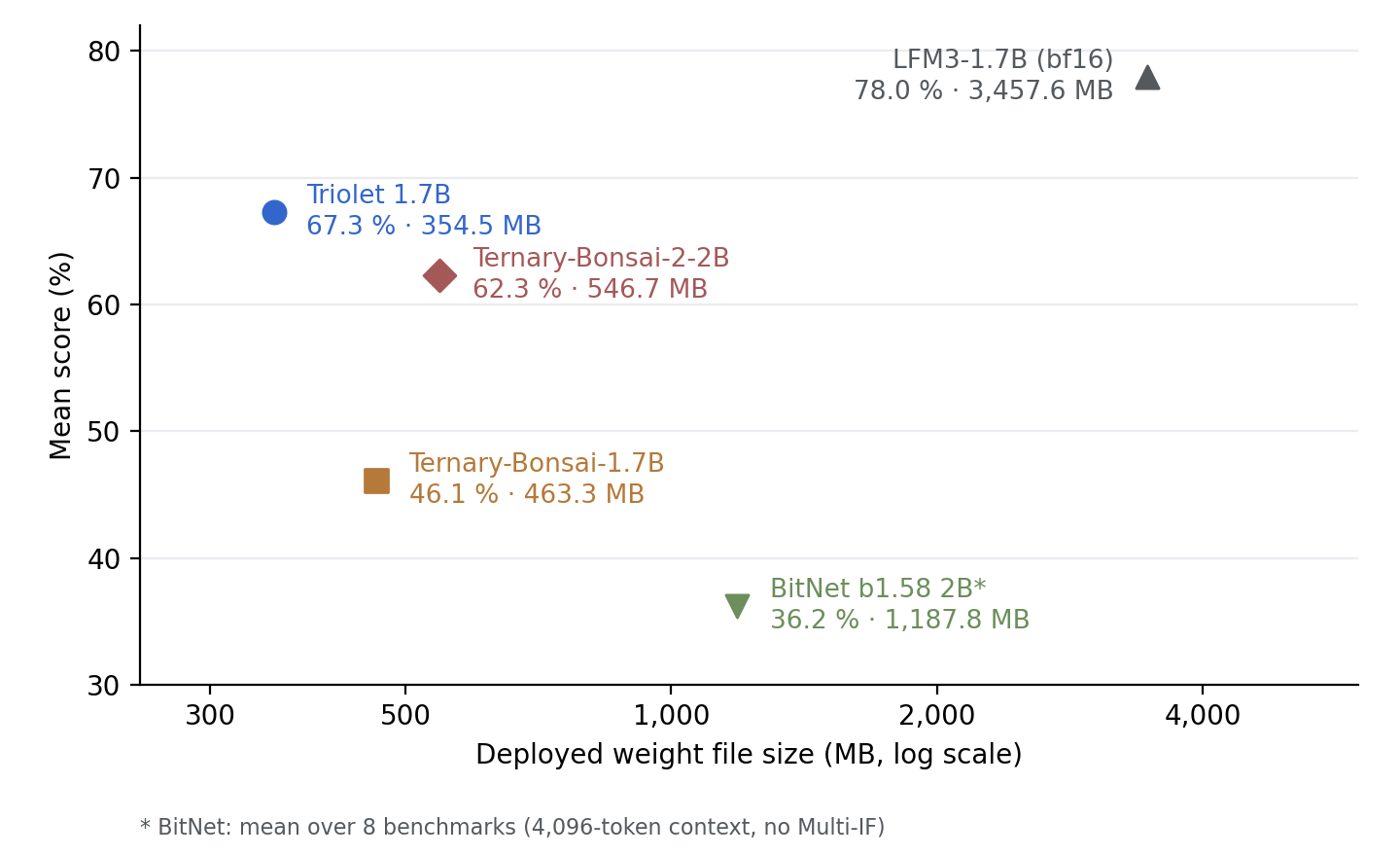
All models were evaluated with the same protocol: EvalScope[4] and vLLM, thinking enabled, temperature 0.6, top-p 0.95, up to 32,768 generated tokens; only the final answer is graded. Numbers in parentheses are standard errors.
| Benchmark | Triolet 1.7B | Ternary-Bonsai-2-2B | Ternary-Bonsai-1.7B | BitNet b1.58 2B[c] | LFM3-1.7B (bf16) |
|---|---|---|---|---|---|
| IFEval | 92.1 (1.2) | 87.4 | 73.0 | 53.0 | 94.6 |
| IFBench | 55.7 (3.0) | 48.2 | 19.1 | 12.4 | 68.4 |
| Multi-IF, turn 1 | 88.1 (0.5) | 82.8 | 64.6 | n/a | 91.7 |
| GSM8K (arithmetic) | 90.1 (0.8) | 81.7 | 65.3 | 70.4 | 93.5 |
| MATH-500 | 83.6 (1.7) | 78.4 | 51.6 | 42.6 | 97.0 |
| MMLU-Redux (knowledge) | 70.3 (0.6) | 67.9 | 53.7 | 46.1 | 79.8 |
| MuSR (reasoning) | 59.7 (1.8) | 59.0 | 47.8 | 37.8 | 61.2 |
| GPQA Diamond (science) | 38.9 (3.5) | 36.9 | 30.3 | 23.2 | 61.1 |
| LiveCodeBench v6 (code) | 27.4 (3.4) | 18.3 | 9.1 | 3.4 | 54.9 |
| Mean of the nine | 67.3 | 62.3 | 46.1 | 36.2* | 78.0 |
| HumanEval+ (code)[a] | 89.0 (2.4) | 51.8 | 44.5 | 34.1 | 91.5 |
Triolet is ahead of Ternary-Bonsai-2-2B on all ten benchmarks, narrowly on MuSR and GPQA Diamond, where the gap is below one standard error. It is well ahead of the same-size Ternary-Bonsai-1.7B (46.1 mean) and of BitNet b1.58 2B (36.2 over eight benchmarks). A second sampling run with another seed gives close scores (for example 88.2 on Multi-IF and 83.6 on MATH-500). The original model remains clearly stronger on hard mathematics, science and code.
The browser engine computes with 8-bit integer activations. On real benchmark traces it picks the same most likely token as the floating-point model at 385 of 387 positions, with a mean divergence of 0.00016 nats. On 304 GSM8K, MATH-500 and IFEval questions put to both versions, the browser engine solves as many as the reference model (265 each): −5.5 points on GSM8K, +6.3 on MATH-500 and +2.1 on IFEval, none of these differences being statistically established.
Usage
- In the browser: the chatbot page downloads the 355 MB once, then answers offline. It can search Wikipedia when the model decides to, and an exact calculator handles arithmetic.
- On a computer: the Hugging Face repository provides the dense model for Transformers and vLLM, GGUF files for llama.cpp, an MLX version for Macs and the WebAssembly engine file.
Limitations
- On long programming problems the reasoning does not always conclude: on LiveCodeBench, 47% of thoughts reach the token limit unfinished, sometimes repeating themselves (26% for Ternary-Bonsai-2-2B). On MATH-500 it is the other way round: 8% versus 18%.
- Like any small model, it can state false facts, especially without Wikipedia search.
- Long contexts, languages other than French and English, and tool use have not been evaluated.
License
Triolet is a modified version of LFM3-1.7B and remains under Liquid AI's LFM Open License v1.0. Its weights are open, but the license is not an open-source one: commercial use is limited to organizations with less than USD 10 million in annual revenue. LISN's modifications are described alongside the files.
See also
How to cite
@misc{pommeret2026triolet,
  title        = {Triolet 1.7B: a ternary language model that runs in the browser},
  author       = {Pommeret, Luc},
  year         = {2026},
  organization = {LISN, Universit{\'e} Paris-Saclay, CNRS},
  howpublished = {\url{https://huggingface.co/Zual/Triolet-1.7B}}
}
Notes and references
Notes
- HumanEval+ is scored outside EvalScope, with the same script for every model. It is excluded from the mean: an audit of the training data found fragments of 7 reference solutions inside code-editing requests. The same audit found variants of 27 MATH-500 problems in the prompts (same wording, other values); without them Triolet scores 82.7% on MATH-500.
- Upper estimate: maximum H100 GPU power (700 W) for the whole duration, excluding CPUs, network and cooling; average carbon intensity of French electricity.
- BitNet b1.58 2B was evaluated with llama.cpp (ternary weights unpacked to BF16), without thinking, at its native 4,096-token context: Multi-IF dialogues do not fit, so its mean covers eight benchmarks. Ternary-Bonsai-1.7B was capped at 30,720 generated tokens, its context being 32,768 tokens. Sizes: files distributed by their authors (Q2_0 for Bonsai, i2_s for BitNet).
References
- Liquid AI, "LFM3-1.7B", Hugging Face, October 2026.
- PrismML, "Ternary-Bonsai-2-2B", Hugging Face, 2026.
- IDRIS, "Jean Zay", CNRS.
- ModelScope, "EvalScope", GitHub.
External links
- Model card and files (Hugging Face)
- Chat with Triolet in your browser
- Source code of the engine and page (LISN GitLab)